
Executive Summary
The knowledge-worker AI market is moving past the first wave of chatbots. The next category is not just "ask an AI for help." It is delegate a task to a system that can plan, use tools, work across files or applications, and return a usable deliverable.
That shift changes how buyers should evaluate AI platforms. Model quality still matters, but it is no longer the whole story. The stronger question is: where does the work run, what can the agent access, how much autonomy is allowed, and what kind of output does the product reliably produce?
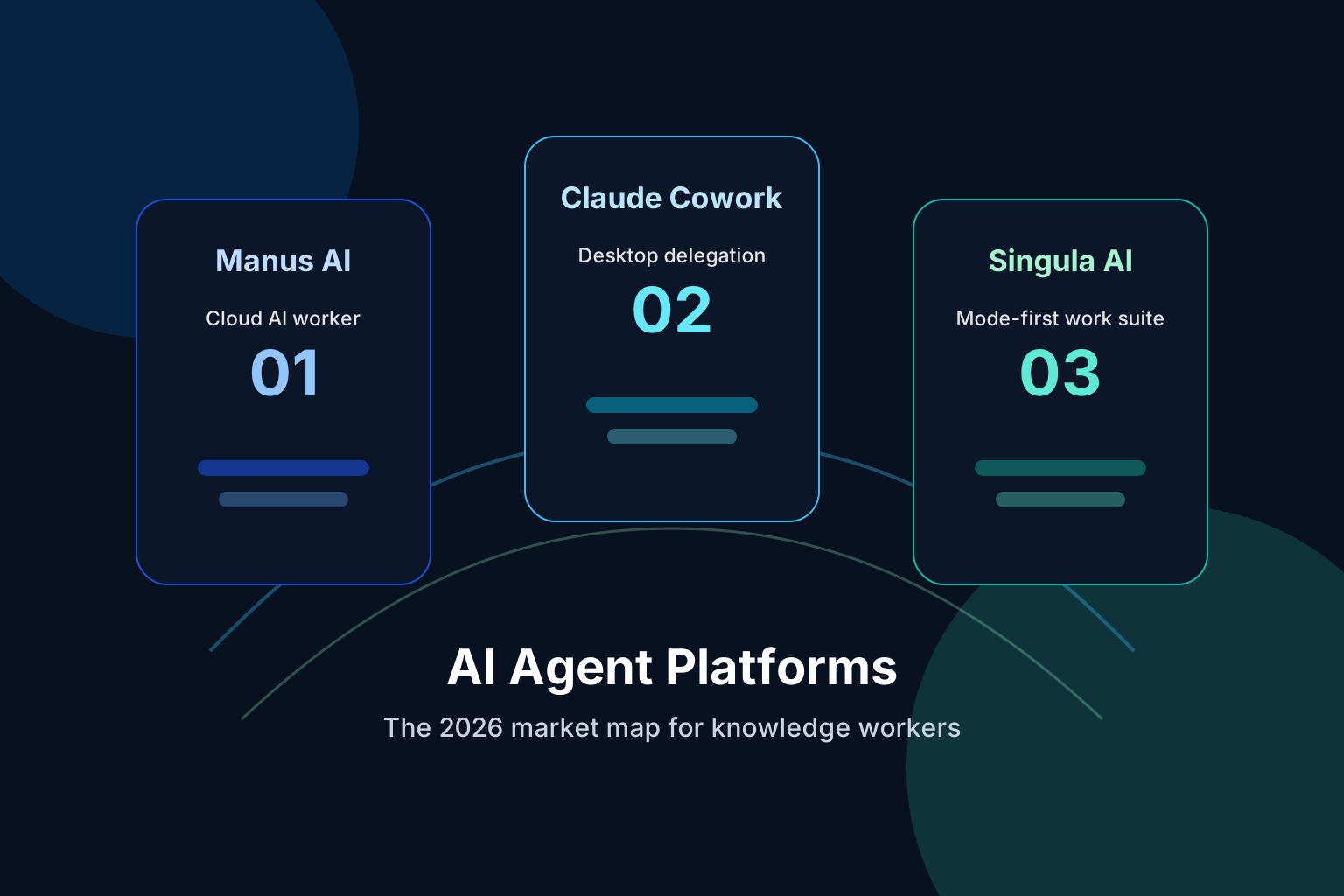
This article compares three visible approaches:
| Vendor | Core market bet | Best shorthand |
|---|---|---|
| Manus AI | A general-purpose, cloud-executed agent can become a broad execution layer for individuals and businesses. | Cloud AI worker |
| Claude Cowork | Knowledge workers need Claude Code-like autonomy for local files, desktop apps, and repeatable document work, but with a non-technical interface. | Desktop delegation agent |
| Singula AI | Knowledge work is easier to sell and use when agents are packaged as named, outcome-specific work modes: People, Slides, Data, Docs, Research, Image, Video, Canvas. | Mode-first AI work suite |
The most important distinction is not which product is "more agentic." It is which buyer problem each product makes legible.
- Manus sells a broad "leave it to the agent" story.
- Claude Cowork sells a precise "hand off messy desktop work" story.
- Singula sells a "super agents for work" story organized around concrete deliverables.
From Chatbots to AI Work Platforms
Early AI assistants made knowledge workers faster at writing, summarizing, coding, and ideating. The new generation goes further: the user assigns work, and the system may browse, read files, create documents, run code, modify spreadsheets, assemble slides, search for people, or coordinate across connected tools.
The category is converging around five promises:
- Autonomy: The product can plan and execute multi-step tasks with fewer user prompts.
- Tool use: The product can access browsers, files, apps, APIs, cloud tools, or desktop environments.
- Deliverables: The output is a usable artifact: a report, spreadsheet, deck, website, prospect list, analysis, or organized folder.
- Persistence: Work can happen over time through long-running jobs, scheduled tasks, recurring workspaces, memory, or projects.
- Oversight: The user remains responsible for high-stakes decisions, permissions, and review.
The Three Market Patterns
1. Cloud General Agents
Cloud general agents run in vendor-managed environments and execute broad tasks remotely. The appeal is simple: ask for an outcome and let the agent work while the user does something else.
Manus AI is the clearest example in this comparison. Public materials position Manus as a general-purpose AI agent for research, analysis, workflow automation, coding, app creation, website generation, document work, and business operations.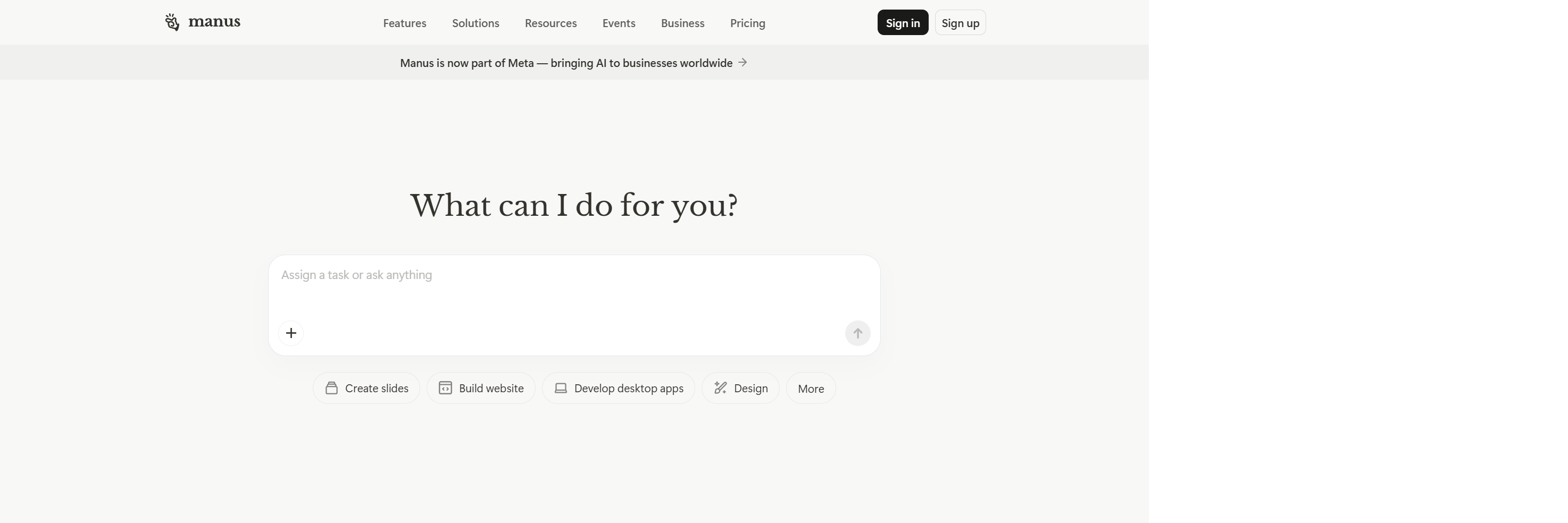
The cloud-agent model has real advantages:
- Work can continue without depending entirely on the user's laptop.
- The vendor can improve orchestration, model routing, tool access, and compute centrally.
- Team workspaces and shared execution environments are easier to package.
- The product can feel like an always-available AI worker rather than a local assistant.
Manus also has a major distribution wildcard: its public announcement that it joined Meta. If Manus-style agents eventually connect to Meta's business tools, messaging surfaces, ads workflows, or creator ecosystem, Manus could become more than a standalone agent product. It could become a business automation layer inside Meta's distribution network.
2. Desktop Delegation Agents
Desktop agents start from a different premise: much of knowledge work still lives in local files, folders, spreadsheets, PDFs, browser sessions, and desktop apps. The job is not always to run in the cloud. Sometimes the job is to operate in the messy environment where the user's work already happens.
Claude Cowork represents this pattern. Anthropic frames it as a way to hand off repetitive, messy, or time-consuming work so Claude can work with local files and applications through Claude Desktop.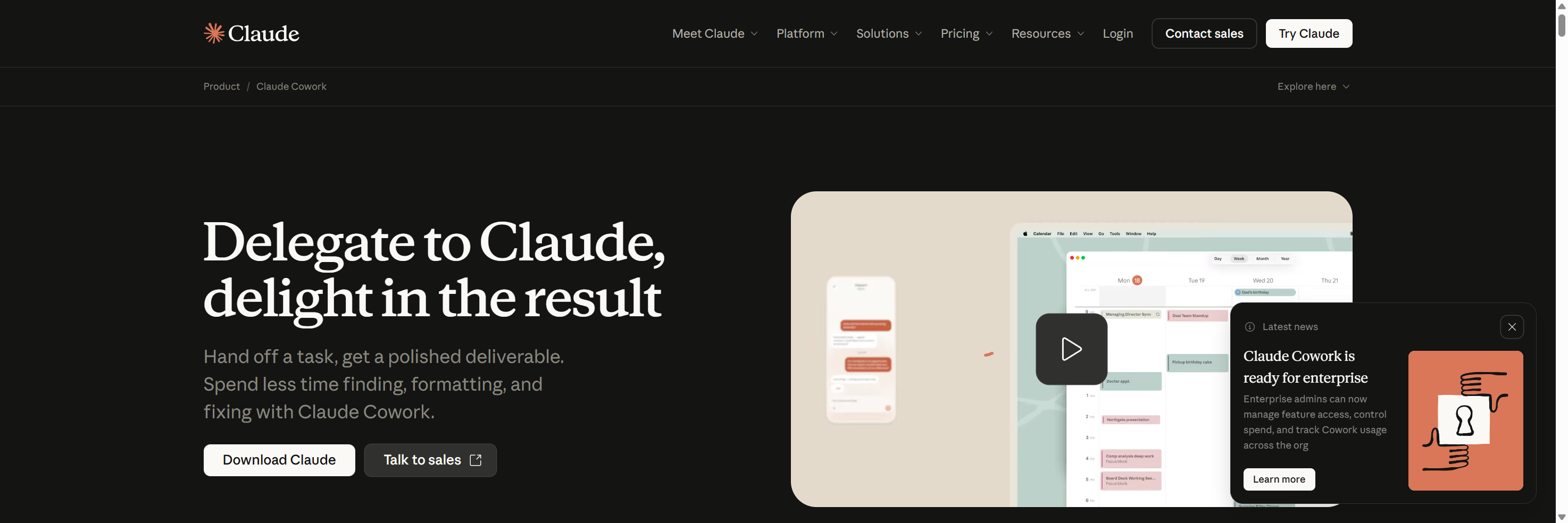
The use cases are concrete:
- Organizing, renaming, sorting, and deduplicating local files.
- Preparing documents from scattered source material.
- Synthesizing research across PDFs, reports, CSVs, JSON, and text files.
- Extracting structured data from dense documents.
- Running recurring tasks where local context matters.
The trust posture is different from a cloud worker. Folder scoping and desktop execution can feel more familiar and controlled. But the model also inherits desktop constraints: the app, machine, and network connection need to be available, and enterprise audit coverage for newer agentic desktop actions may still be evolving.
Claude Cowork's business advantage is bundling. It benefits from Anthropic's model reputation, Claude's paid-plan distribution, and existing enterprise procurement conversations. Buyers do not have to adopt an unknown startup just to test the pattern.
3. Mode-First AI Work Suites
Mode-first AI suites package agent capabilities around recognizable jobs-to-be-done. Instead of asking users to imagine what a blank agent prompt can do, the product presents a menu of work outcomes.
Singula AI is closest to this pattern. Its public positioning centers on "Super AI Agents for Work" and named modes such as People, Slides, Data, Docs, Canvas, Video, Research, and Image.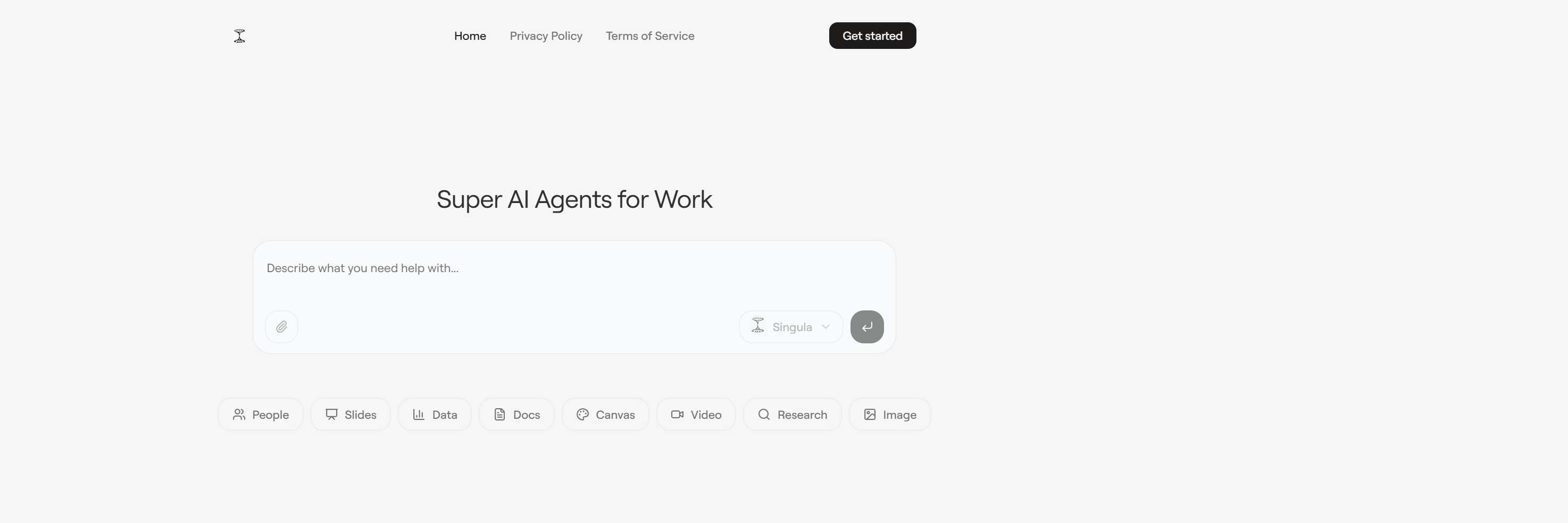
That packaging matters. It makes the product easier for non-technical buyers to understand:
| Mode | Likely buyer job | Competitive frame |
|---|---|---|
| People | Find, research, or prospect professionals. | Recruiting, sales intelligence, expert discovery |
| Slides | Create or improve presentations. | AI presentation tools, analyst decks, sales decks |
| Data | Analyze datasets and generate insights. | Spreadsheet copilots, BI assistants, analyst tools |
| Docs | Draft, rewrite, structure, or edit documents. | Writing assistants, document automation |
| Research | Gather sources, synthesize findings, produce reports. | Deep research agents, analyst assistants |
| Image / Video / Canvas | Create visual or media assets. | Creative AI suites, marketing content tools |
Among Singula's modes, People Search is the most commercially specific capability described in the reviewed material. It maps directly to budgeted work: recruiting, sales prospecting, business development, CRM enrichment, expert discovery, and account research.
The described People Search workflow includes natural-language search, structured filters, profile summaries, relevance scoring, deduplication, and downstream uses such as outreach drafting or meeting preparation. The reviewed product-marketing material claims $0.05 per search / 5 credits for up to 10 profiles, which is a concrete comparison point against LinkedIn Recruiter, ZoomInfo, Apollo, and manual sourcing.
That specificity is valuable, but it also raises diligence questions. Professional-data products need unusually clear answers about source rights, contact-data handling, privacy, opt-outs, acceptable use, exports, CRM/ATS integrations, and current pricing limits.
Side-by-Side Competitive Matrix
| Criterion | Manus AI | Claude Cowork | Singula AI |
|---|---|---|---|
| Category position | Cloud general-purpose AI worker | Desktop knowledge-work delegation agent | Mode-first AI work suite |
| Primary environment | Vendor cloud, accessed via web/desktop/mobile clients | Claude Desktop on macOS/Windows with selected local folders/apps | Web-first SaaS surface from public signals |
| Core user promise | Assign complex work and let the agent execute. | Hand off repetitive desktop/file work and get deliverables. | Use specialized super agents for concrete professional outputs. |
| Workflow packaging | Open-ended task prompt and broad business automation | Folder/project/task workflow inside Claude Desktop | Named modes: People, Slides, Data, Docs, Research, Image, Video, Canvas |
| Autonomy model | Cloud-run tasks, team spaces, parallel work claims | Desktop-run tasks; app and device availability matter | Not fully specified publicly; likely mode-led agent sessions |
| Trust narrative | Team/security claims and Meta-backed distribution, requiring buyer validation | Anthropic safety brand, folder scoping, isolated execution claims, evolving admin coverage | Under-explained publicly; needs more vendor evidence |
| Pricing visibility | Pricing/team pages exist, but task-credit economics require live verification | Included in paid Claude plans, with usage limits | Platform pricing less visible; People Search material gives a concrete unit-price claim |
| Best use cases | Broad automation, research, app/site creation, SMB operations | Documents, files, extraction, local desktop workflows | People search, recruiting, sales, BD, decks, research, data, creative work |
| Primary risk | Cloud governance, credit opacity, overbreadth | Desktop dependency, audit gaps, file-action risk | Public proof gap, people-data compliance, mode-depth risk |
What Buyers Should Evaluate
For any AI agent platform, buyers should look beyond the demo and ask eight questions.
- Work environment: Does work run in the cloud, on desktop, in a sandbox, or across connected apps?
- Autonomy model: Can the agent run asynchronously, schedule work, act in parallel, or continue if the user's device sleeps?
- Permissioning: Are folder scopes, app permissions, approval steps, and action logs clear?
- Deliverable quality: Does the product produce artifacts that are ready to send, or drafts that still require heavy cleanup?
- Workflow completeness: Does it go from input to final output, including sources, formatting, export, and iteration?
- Trust and governance: Are SOC 2, audit logs, admin controls, retention policy, training opt-outs, and DPAs available?
- Integration surface: Does it connect to Slack, Notion, Google Drive, GitHub, CRM, email, browser, spreadsheets, or APIs?
- Economics: Is pricing seat-based, credit-based, usage-based, or negotiated, and are limits transparent?
Strategic Takeaways
The market is fragmenting by work environment
Manus represents the cloud-worker pattern. Claude Cowork represents the desktop-file pattern. Singula represents the mode-first work-suite pattern. These are not minor UI differences; they shape security, reliability, distribution, pricing, and workflow depth.
Distribution is becoming a moat
Manus has Meta. Claude Cowork has Anthropic and the Claude paid-plan base. Singula appears to be building as an independent vendor, which means it needs sharper public proof around product depth, pricing, integrations, governance, and customer outcomes.
Agent autonomy is no longer enough
Buyers now ask about permissions, auditability, data retention, integration depth, cost predictability, and output quality. The winner is not simply the agent that can do the most. It is the product that makes useful delegation trustworthy.
Named workflows can beat generic intelligence
A blank general agent is powerful when users know exactly what to ask. Named modes are powerful when buyers already recognize the job: people search, slide creation, data analysis, document drafting, research synthesis, image generation, video production. The tradeoff is depth: each mode has to compete with specialist point tools.
People-data workflows need extra scrutiny
Singula's People Search mode is commercially interesting because it maps directly to recruiting and sales budgets. But professional-data sourcing, email availability, consent, opt-outs, export rights, and acceptable-use policy must be clear before a buyer treats it as a system of record.
Bottom Line
Manus AI is most differentiated on broad cloud autonomy, category awareness, Meta-backed distribution, and a team/business workflow story. Its main challenge is proving governance and cost predictability for sensitive or high-volume work. Claude Cowork is most differentiated on desktop integration, local files, Anthropic trust, subscription bundling, and non-technical access to Claude Code-style agency. Its main challenge is the desktop dependency and enterprise audit maturity of newer agentic workflows. Singula AI is most differentiated on mode-first packaging and People Search as an AI-native professional discovery workflow. Its main challenge is public proof: data rights, privacy, security, integrations, pricing verification, and customer outcomes need to be easier for evaluators to inspect.The agent-platform market is not collapsing into one universal product. It is splitting into execution environments and buyer jobs. The best platform for a knowledge worker will depend less on who has the flashiest demo and more on the work they need delegated, the data they can share, and the deliverable they expect back.
Research Note
This article is based on an independent market-research survey prepared on April 25, 2026 using public vendor pages, product-positioning materials, help-center content, and Singula People Search product-marketing material reviewed for this research pass. Vendor pages, pricing, availability, data-source claims, and security claims can change quickly. Buyers should re-verify current plan limits, security documentation, data-retention policies, training policies, audit coverage, API availability, integration support, professional-data sourcing, customer references, and enterprise contract terms before making procurement decisions.
Primary public sources reviewed include Manus, Manus team/business materials, Manus's Meta announcement, Claude Cowork by Anthropic, Claude Cowork product materials, Claude Cowork help center materials, and Singula AI.